diversity and inclusion
NASC tells scaffolding firms third-party harassment duty is the October employment law change to watch
The scaffolding trade body has briefed members on Employment Rights Act 2025 changes that took effect in October, including doubled tribunal time limits, a new liability for harassment by third parties and statutory union access.
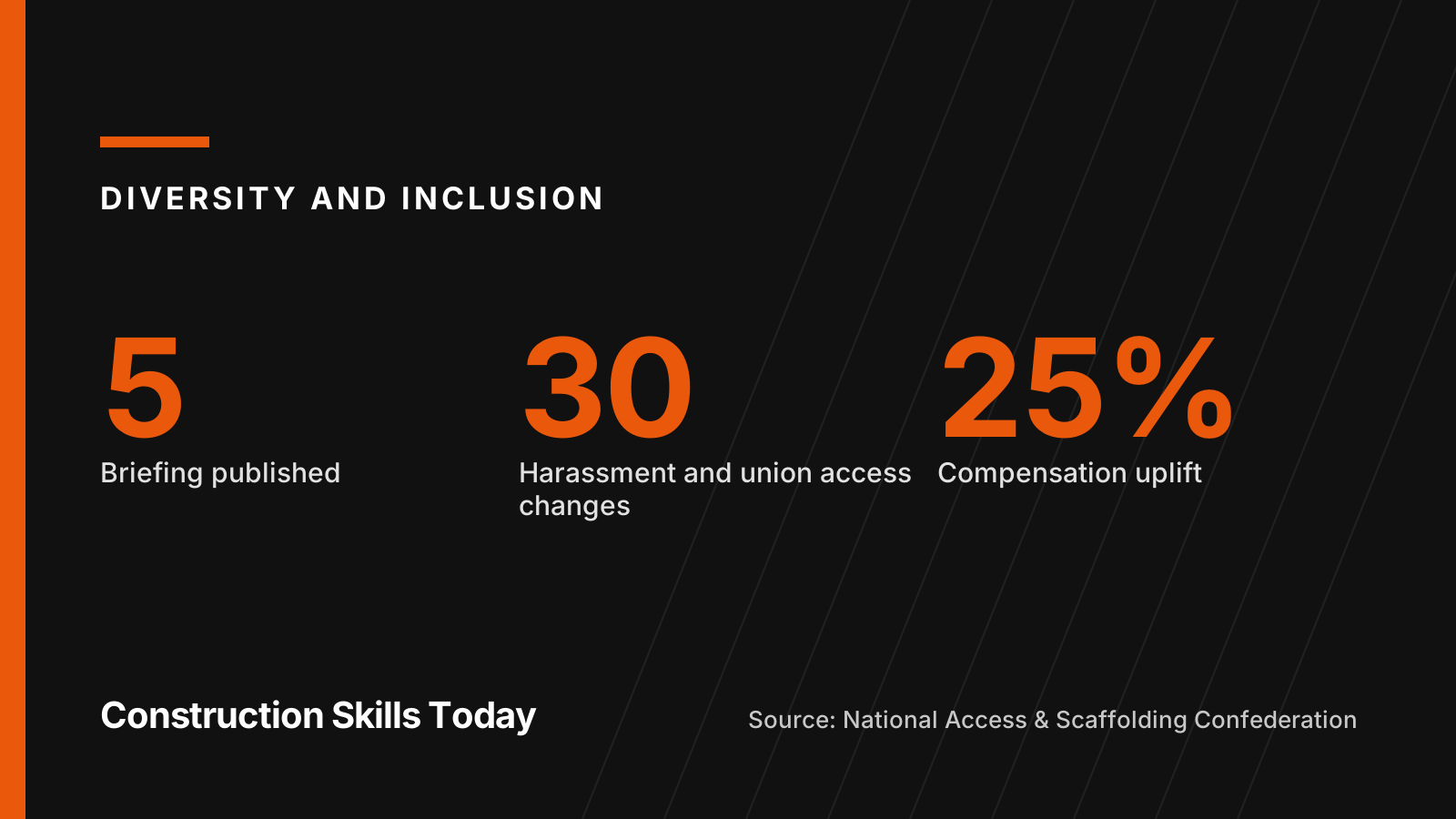
The National Access & Scaffolding Confederation (NASC) has told scaffolding employers that a new liability for harassment of their staff by third parties, in force since 30 October, is the Employment Rights Act 2025 change they should examine hardest.
In a briefing written by Kate King and published on 5 November, the trade body said two of the October changes would matter to most scaffolding employers, with more to follow in January.
NASC said the third-party duty is significant for its sector because scaffolding operatives spend their working lives on other people's sites, alongside other trades, principal contractors and clients. Those, it said, are exactly the third parties the duty has in mind, and the fact that conduct came from someone not on an employer's payroll is no longer the end of the matter.
Harassment
From 30 October the standard employers must meet rose from taking reasonable steps to prevent sexual harassment to taking all reasonable steps, NASC said. Where a tribunal finds that duty was breached in a successful claim, compensation can be increased by up to 25%.
Employers are now also liable for harassment of their employees by third parties unless they took all reasonable steps to prevent it. NASC said two features make this important for scaffolding: the duty is not limited to sexual harassment and covers harassment connected to any protected characteristic, and a single incident can be enough.
The trade body advised members to include third-party risk in workplace risk assessments, make sure reporting routes cover conduct by people outside the business, and consider whether their contracts set expectations with the firms they work alongside.
The Commencement No. 6 regulations on legislation.gov.uk brought sections 20, 21 and 22 of the Act, covering all reasonable steps, harassment by third parties and the power to define reasonable steps, into force on 30 October 2026. The Department for Business and Trade's timeline describes the measure as an obligation on employers not to permit the harassment of their employees by third parties.
NASC said regulations setting out what counts as reasonable steps on harassment are expected in 2027 or 2028.
Tribunal time limits
The first October change, from 1 October, doubled employment tribunal time limits, with most claims now carrying a six-month limit rather than three. NASC said the extension applies only where the act or failure happened on or after 1 October, so it is not retrospective.
The practical consequence, according to NASC, is record keeping: if claims can stay live for six months, documentation needs to survive that long in a usable state.
Government guidance on business.gov.uk says the longer limit brings most claims into line with the time limit for statutory redundancy and equal pay claims, and is intended to give employees and employers more time to resolve disputes internally or through conciliation. It tells employers to update policy documents and handbooks that refer to the old three-month limit.
The Department for Business and Trade timeline adds that, for breach of employment contract claims in Scotland, the change takes effect on 9 November 2026.
Union access
NASC said the remaining trade union reforms also took effect at the end of October. Unions now have statutory rights of access to workplaces for recruitment, organising and collective bargaining, which can include digital access. Where arrangements cannot be agreed, a union can apply to the Central Arbitration Committee (CAC), which can order access and impose financial penalties for non-compliance.
The regime applies to employers that do not currently recognise a union, and NASC advised members to know in advance who in the business would handle a request.
HM Revenue & Customs' October employer bulletin says access can be physical, digital or both, and that employers with fewer than 21 workers across all their workplaces are exempt from the access provisions. The bulletin says the CAC can issue fines for breaches of an access agreement.
The CAC announced on 8 July 2026 that it had added 23 members, including five deputy chairs, nine employer members and nine worker members, ahead of its new functions. It said that from October 2026 it would determine right of access terms where negotiations between employers and unions are unsuccessful.
What comes next
NASC said that from January 2027 the qualifying period for unfair dismissal is expected to fall to six months and the cap on compensatory awards is expected to be removed. The government timeline lists the six-month qualifying period for dismissals from 1 January 2027.
NASC also said restrictions on fire and rehire are expected in January. The government timeline, however, lists fire and rehire protections under March 2027, and says all future dates remain subject to parliamentary processes and may change.
Measures NASC listed as still working through in 2027 include regulation of umbrella companies, restrictions on zero hours contracts, flexible working reforms, changes to collective consultation thresholds, expanded bereavement leave, enhanced protections for pregnant women and new mothers, and mandatory gender equality and menopause action plans.
Citation, which NASC describes as its Services and Ancillary Products Manager, has produced a free guide for members covering what has been implemented, what changed in October and what is still to come.
NASC describes itself as a not-for-profit trade body governed by its Council, active since 1945. The government timeline lists regulation of umbrella companies for December 2027.
On the record: Citation
Sources
- National Access & Scaffolding Confederation (opens in a new tab) (accessed 2026-11-05)
- GOV.UK (Department for Business and Trade) (opens in a new tab) (accessed 2026-11-05)
- business.gov.uk (UK government) (opens in a new tab) (accessed 2026-11-05)
- GOV.UK (HM Revenue & Customs) (opens in a new tab) (accessed 2026-11-05)
- legislation.gov.uk (opens in a new tab) (accessed 2026-11-05)
- GOV.UK (Central Arbitration Committee) (opens in a new tab) (accessed 2026-11-05)
- National Access & Scaffolding Confederation (opens in a new tab) (accessed 2026-11-05)
This story was researched from the primary sources above and checked against them before publication. Spotted an error? Tell us and we will correct it promptly.