awards
ECITB labour forecasting tool shortlisted at EIC World Energy Supply Chain Awards
The engineering construction training board's Labour Forecasting Tool, which forecasts that 40,000 extra workers could be needed by 2030, earned a place on the Collaboration shortlist at the Energy Industries Council's London ceremony.
The Engineering Construction Industry Training Board (ECITB) has been shortlisted in the Collaboration category at the Energy Industries Council's 2026 World Energy Supply Chain Awards for its Labour Forecasting Tool, the board said on 30 October.
The ceremony took place at the Marriott Hotel in Grosvenor Square, London. According to the ECITB, it was shortlisted alongside AAL Shipping, Cargostore, Cokebusters and Forsyths, with Siemens the overall winner. The board was also featured in the EIC's Survive & Thrive insight report for 2026.
The ECITB said an independent judging panel recognised how the tool helps the engineering construction industry plan for future workforce needs and prepare for growth.
Andrew Hockey, ECITB Chief Executive, said: "it is vital that decisions made by governments, asset owners, contractors and other industry partners to tackle these challenges are informed by evidence."
The tool
The ECITB developed the Labour Forecasting Tool with Whole Life Consultants and a technical reference group of industry stakeholders. It launched in November 2023 and was updated in May 2025 using findings from the ECITB Workforce Census.
Before the tool existed, the board said, the industry had no consistent way to track labour supply and demand, identify shortages or anticipate skills gaps linked to major projects.
The 2023 version drew on data from 1,500 active and future engineering construction projects. The ECITB said the current version uses publicly stated timescales on 3,000 projects, and the May 2025 update added the ability to model the effect of project delays or cancellations on demand. The tool provides workforce insights across regions and sectors up to 2035.
Hockey said the tool "has provided critical insights into the make-up and future direction of industry and allowed for evidence-based, targeted initiatives and interventions to tackle looming skills shortages."
The forecasts
At launch in November 2023, the tool forecast a shortfall of 40,000 workers by 2028. The May 2025 update kept the 40,000 figure but moved peak demand to 2030, which the ECITB attributed to delays on some projects that now coincide with other planned activity, along with a wave of possible retirements in key roles.
The board said the 40,000 additional workers could be needed on top of an existing supply of 114,000, a 19% rise in demand between 2025 and 2030, taking the total workforce to more than 135,000.
The May 2025 update described 2026 as a pivotal year, with nearly 4,400 additional workers potentially needed. The ECITB said 23% of these workers could be required to work on carbon capture projects. Roles most in demand include mechanical fitters, electrical technicians, process engineers, project managers, pipefitters, welders and design technicians, the ECITB said.
The census
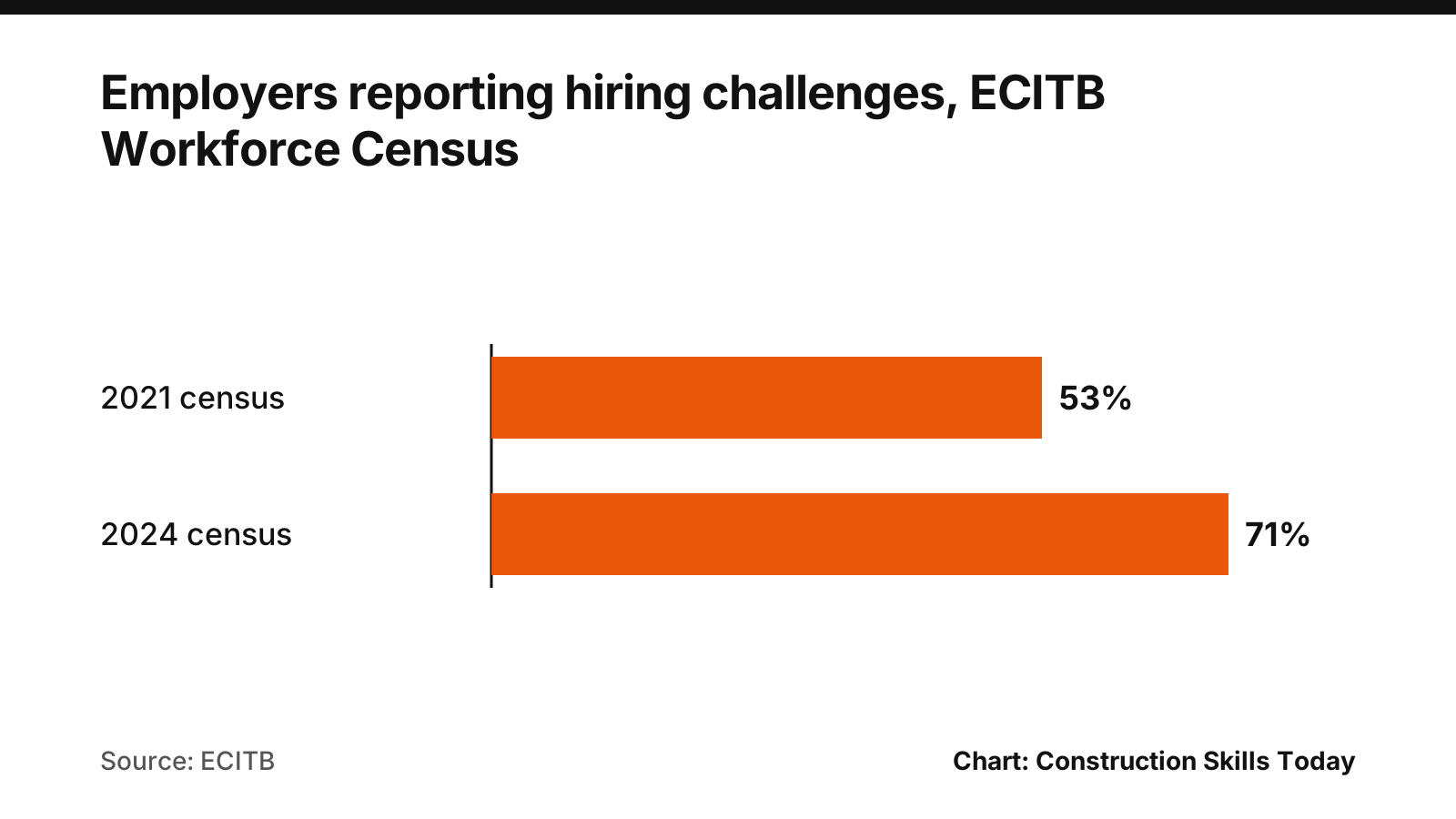
The Workforce Census that feeds the tool achieved a response rate covering 78.8% of the workforce in its 2024 edition, up from 54% previously, according to the ECITB. It found 71% of employers reported challenges hiring workers, and that the share of workers aged over 60 had risen to 14.7%.
| Census year | Employers reporting hiring challenges |
|---|---|
| 2021 | 53% |
| 2024 | 71% |
The ECITB said the tool and census have fed into strategies including reports on the national infrastructure and construction pipeline, sectoral and regional skills gaps and the Government's Clean Power 2030 Action Plan.
Who attended
Those pictured at the awards for the ECITB included Mark Riley, Project Controls Lead at Phillips 66 Limited, who sat on the technical reference group during the tool's development; ECITB Director of Strategy and Policy David Nash; ECITB Head of Research, Insights and Evaluation Franziska von Blumenthal; Mark Rouse, Director for the Nuclear Skills Plan and Co-chair of the Nuclear Skills Delivery Board; and Doug Forbes, Director at Whole Life Consultants Limited.
The EIC said 136 member companies entered the 2026 WESCAs across 16 categories. It holds six ceremonies each October and November, in London, Houston, Rio, Dubai, Milan and Kuala Lumpur.
The ECITB is an arm's-length body reporting to the Department for Work and Pensions and is funded by a statutory training levy. It says it invests over £32m a year in skills development for the industry.
On the record: Department for Work and Pensions
Sources
- ECITB (opens in a new tab) (accessed 2026-10-31)
- ECITB (opens in a new tab) (accessed 2026-10-31)
- ECITB (opens in a new tab) (accessed 2026-10-31)
- ECITB (opens in a new tab) (accessed 2026-10-31)
- ECITB (opens in a new tab) (accessed 2026-10-31)
- Energy Industries Council (EIC) (opens in a new tab) (accessed 2026-10-31)
- ECITB (opens in a new tab) (accessed 2026-10-31)
This story was researched from the primary sources above and checked against them before publication. Spotted an error? Tell us and we will correct it promptly.